PMU Laser Removal: The Science of Advanced Depigmentation in Miami-Dade.
The rise of micropigmentation has brought a growing need: the correction of unsatisfactory results. PMU Laser Removal (permanent makeup removal) has established itself as the gold standard for those seeking to clear their face of migrated pigments, asymmetrical designs, or shades that have shifted toward unnatural colors. At BG Integrative Studio, we approach this process not just as an aesthetic act, but as a skin recovery intervention at our Coral Gables, Doral, and Aventura locations. In Miami-Dade County, sun exposure and the use of varying quality cosmetic products present unique challenges. Erasing a previous job requires understanding the interaction between laser light and the chemistry of the color deposits lodged in the dermis.
What is PMU Laser Removal and how does it interact with your body?
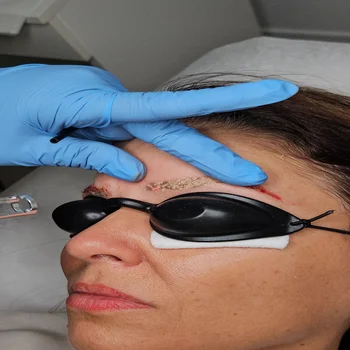
Unlike color application, which is an additive process, PMU Laser Removal is a subtractive one. We do not "burn" the ink; we use ultra-high-speed light pulses that impact the pigment particles. This impact generates a photoacoustic effect that fragments the pigment into microscopic particles. Once the laser breaks these color capsules, your immune system steps in. Macrophages (your body’s cleaning cells) transport those residues toward the lymphatic system to be naturally expelled. It is a team effort between our technology and your own biology.
The Importance of Picosecond Technology
For years, tattoo removal was performed with nanosecond lasers. While effective, this equipment generated significant residual heat in the tissue. At BG Integrative Studio, we have evolved toward Picosecond technology. What is the real difference? A picosecond is a trillionth of a second. By firing energy in such brief intervals, the pigment is pulverized into much finer particles than with nanoseconds, making it easier for your body to eliminate them in fewer sessions and with minimal collateral damage to the surrounding skin. For a patient in Miami, this means less inflammation and faster recovery.
Why do eyebrows change color during the process?
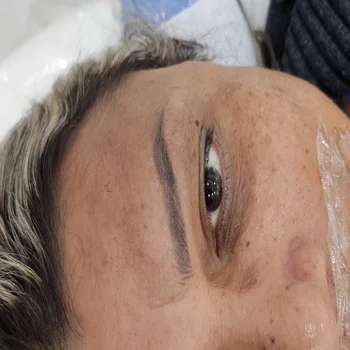
A major fear for patients in Florida is seeing their eyebrows turn orange or green after the first laser session. This is an expected chemical phenomenon when working with low-quality or old pigments. Many micropigmentation pigments are blends of several colors. The laser usually removes dark tones (black and blue) first. As these disappear, base tones like red or yellow are exposed. At BG Integrative Studio, we explain that this is a sign of progress: we are "peeling" away layers of color until we reach clean skin. It is not an error; it is the physics of the lightening process.
The Challenge of Metal Oxides in Miami-Dade
In Miami-Dade County, we find a high incidence of work performed with pigments containing high levels of titanium dioxide or iron oxides. These are used for opacity but present a challenge for the laser. Titanium dioxide can undergo "paradoxical darkening" when hit by the laser, instantly turning dark gray or black. For this reason, we perform an exhaustive prior evaluation. If we detect these metals, we adjust the wavelength and power to avoid chemical reactions that could complicate the final result.
How many sessions are actually necessary?
The number of sessions depends on variables such as:
- - Age of the work: Older inks are often deeper.
- - Saturation: The more compact the brow, the more layers of pigment to break.
- - Pigment type: Organics usually require fewer sessions than heavy inorganics.
- - Lymphatic health: Your body’s ability to expel the ink is as important as the laser itself.
On average, lightening for a new design requires 2 to 4 sessions. Total removal could extend to 6 or 8, always spaced at least 6 to 8 weeks apart to allow the skin to recover.
Comfort and Sensation
Does it hurt? The sensation is commonly described as the snap of a hot rubber band. However, at BG Integrative Studio, patient experience is a priority. We use cryogenic air cooling systems to numb the area before and during the procedure. Since sessions are brief (often under 5 minutes), the discomfort is very tolerable.
Laser vs. Chemical Removal: Which to choose?
Sometimes the laser is not the only option. Chemical removers (saline-based or fruit acids) work through osmosis. At BG Integrative Studio, we are experts in both techniques and often combine them. While the laser is unbeatable for dark, deep pigments, chemical removal can be the ideal complement for very light, white, or intense green pigments that the laser cannot "see" well.
Can I get new eyebrows after laser?
Yes! In fact, that is the goal for most of our clients in Coral Gables and Doral. However, the skin must be fully recovered. We recommend waiting at least 12 weeks after the last laser session before attempting a new microblading or shading procedure.
The Path to a Clean Canvas
PMU Laser Removal represents the evolution of the beauty industry toward clinical responsibility. We are no longer trapped by the mistakes of the past. Thanks to picosecond technology and a deep knowledge of dermal chemistry, we can offer your face a second chance. If you are ready to reclaim your gaze, schedule a technical assessment at our locations. At BG Integrative Studio, we transform frustration into a new beginning. Your face is your calling card; make sure it tells the story you want.